


In early 2026, the quiet expanse of the Arctic — specifically the vast island of Greenland — became the unlikely epicentre of a major international crisis involving the United States, European Union, Denmark and NATO. What started as a revived interest by U.S. President Donald Trump in acquiring Greenland quickly morphed into a transatlantic confrontation, shaking decades-old assumptions about cooperation between Washington and its closest allies.
Greenland’s Strategic Importance
Greenland, the world’s largest island, is an autonomous territory within the Kingdom of Denmark and strategically located between North America and Europe. Its position in the Arctic has grown in geopolitical importance as climate change opens new shipping routes and competition intensifies for access to natural resources and high-latitude military footholds. Trump has framed Greenland as vital to U.S. national and global security — arguing that its location and potential strategic assets make American control essential to countering rivals like Russia and China.
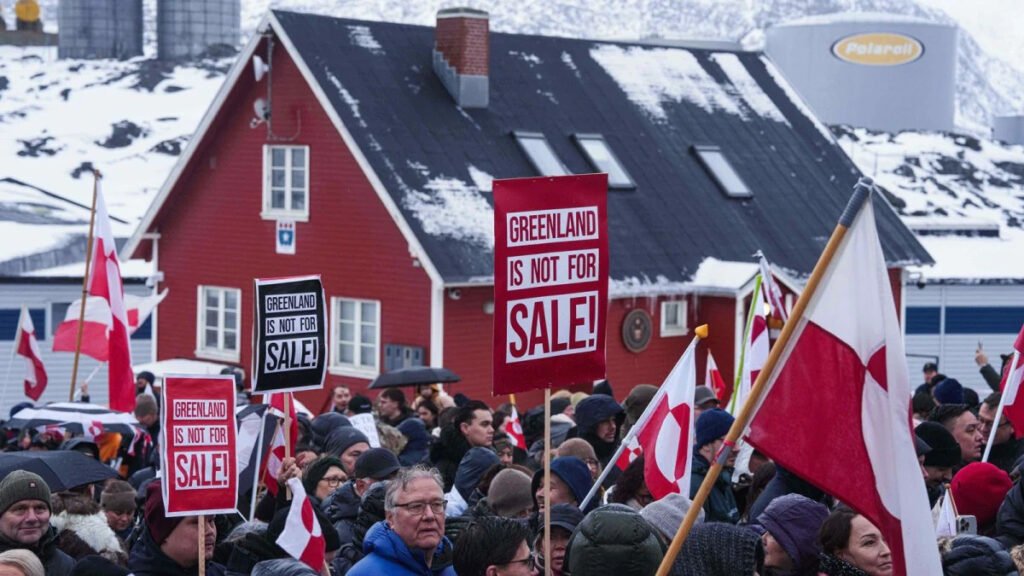
However, European leaders and experts see this differently: Greenland’s sovereignty is enshrined in international law, and its people — alongside Danish authorities — strongly oppose any transfer of control to the United States. Danish leaders emphasised that Greenland is not for sale and that negotiations over sovereignty must involve the island’s indigenous population.
The Controversy Explodes at Davos
The issue came to a head at the World Economic Forum in Davos in January 2026, where Trump openly pressed his agenda. In a speech that shocked many in the international community, he reaffirmed that the United States was seeking “immediate negotiations” over Greenland and insisted that American ownership would strengthen global security. Trump also publicly criticised European policies, directly linking Greenland to broader disputes over NATO burden-sharing and economic relations.
To pressure allies into supporting his goal, Trump threatened tariffs on eight European countries — including Denmark, France, Germany, the UK and others — beginning at 10 % and later rising to 25 % unless they agreed to negotiate Greenland’s transfer. This move triggered swift criticism from EU officials who warned that such economic coercion could damage transatlantic relations and undermine cooperation on security and trade.
European Backlash and Diplomatic Tensions
European leaders reacted with alarm and unity. The European Parliament halted work on a major U.S.–EU trade deal in response to Trump’s tariff threats, reflecting broader fears that Washington’s tactics could destabilise mutual trust and economic ties. EU Council President António Costa said the crisis was testing Europe’s security, principles and prosperity, highlighting how Trump’s approach challenged longstanding norms of diplomatic engagement.
Denmark — the sovereign state responsible for Greenland — took a firm stance. Its prime minister insisted that sovereignty cannot be negotiated away and called for “constructive dialogue” within the framework of respect for territorial integrity. Demonstrations erupted in Copenhagen and Nuuk under slogans like “Greenland is not for sale”, the largest protests in the territory’s history.
Russia also weighed in, watching the dispute with a mix of glee and strategic calculation as divisions between the U.S. and Europe became more visible. Their commentary underscored how internal Western tensions can be exploited by geopolitical rivals.
A Diplomatic U-Turn — But Tensions Remain
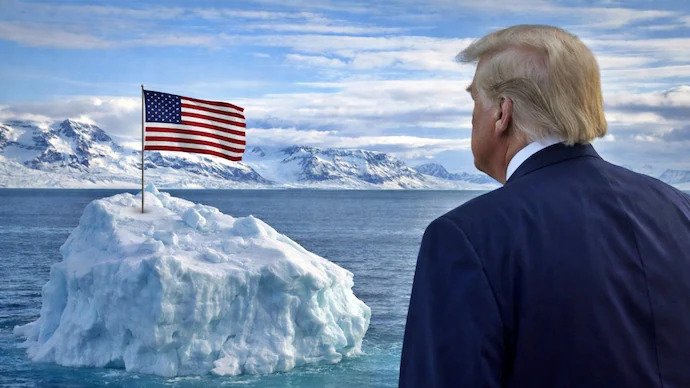
By mid-January, Trump’s administration announced a partial retreat: the president withdrew the tariff threats and made clear he would not use military force to acquire Greenland. Instead, he claimed a “framework” had been agreed with NATO Secretary-General Mark Rutte to pursue future discussions about Arctic cooperation and defence.
Despite this apparent de-escalation, European officials stressed that fundamental disagreements remain. Denmark reiterated that Greenland’s future cannot be decided without Greenlanders themselves, and Brussels warned that trust has been eroded. Several leaders also emphasised that any security cooperation in the Arctic must respect international law and alliance protocols.
What This Means for Transatlantic Relations
The Greenland flashpoint revealed deeper questions about the U.S.–Europe partnership. It has exposed cracks in NATO cohesion, raised concerns about American diplomatic approaches with allies, and underscored how strategic assets can become leverage points in high-stakes international politics. Even if the immediate crisis has been defused, its reverberations continue to shape discussions about alliance unity, Arctic strategy and the future of global cooperation in an increasingly contested world.